
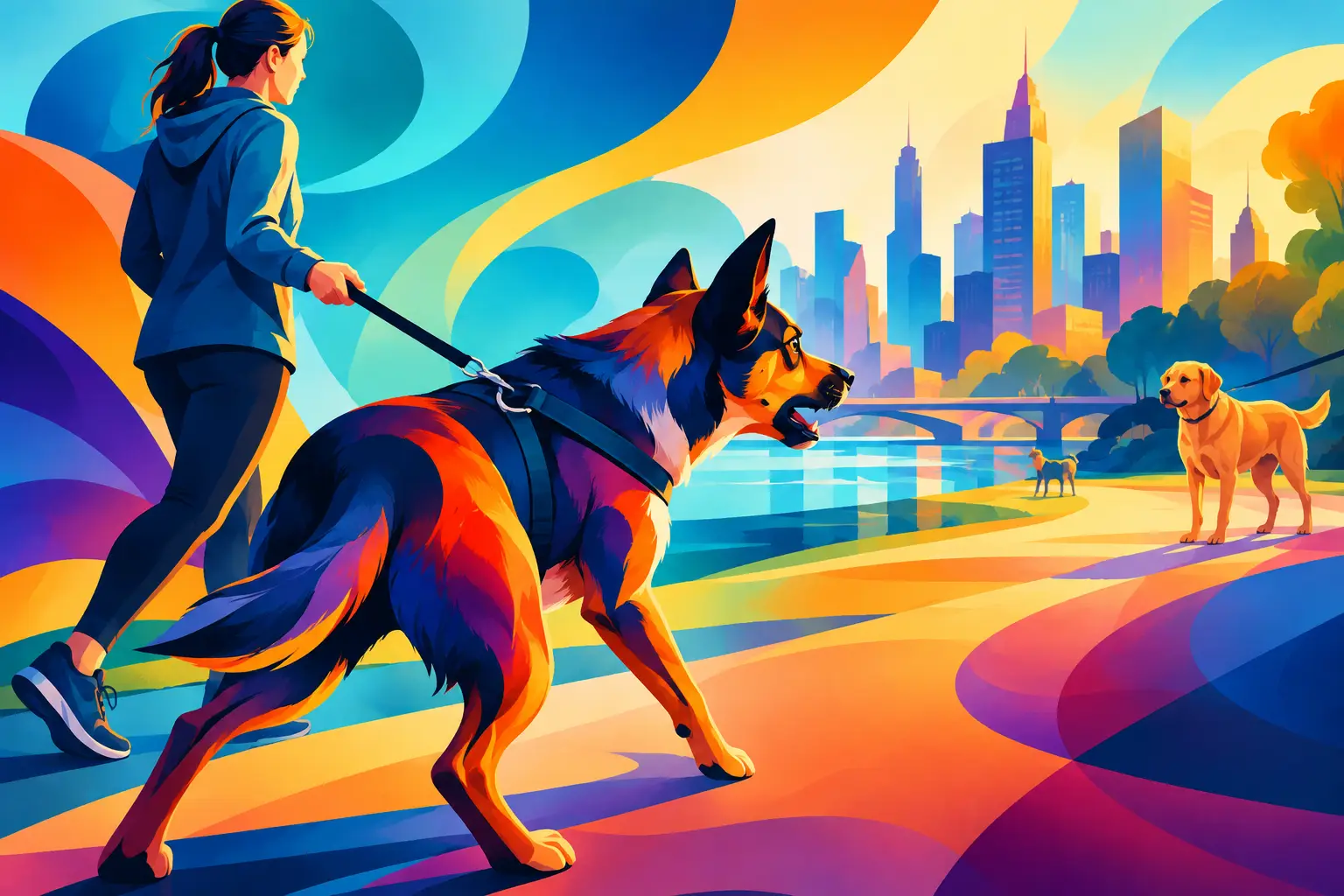
A walk can become stressful long before your dog barks or lunges. You may spot another dog across the road, tighten the lead and start planning an exit. Reactive dog training Melbourne owners seek should make these everyday moments safer, clearer and more manageable – not leave you avoiding the footpath, local park or visitors at home.
Reactivity is a behaviour, not a diagnosis or a sign that your dog is beyond help. A dog may bark, pull, spin, growl or lunge when it sees another dog, person, bicycle or moving vehicle. These reactions can look like aggression, but the cause may be fear, frustration, over-arousal, uncertainty or a learned habit that has been rehearsed too often.
The practical goal is not to pretend your dog will never notice a trigger. It is to build your ability to guide them before they tip into an uncontrolled reaction, while teaching the dog better responses over time.
Why dogs become reactive on lead
Dogs have less freedom to move away when they are attached to a lead. A friendly dog that would normally create space or approach in a curved path may feel trapped when another dog comes directly towards it. Add a narrow footpath, a busy café strip, a surprise around a parked car or an owner holding a tense lead, and the situation can quickly become too much.
For some dogs, reactivity begins in adolescence. They become stronger, more alert to their surroundings and more willing to test boundaries. Others have had limited exposure to dogs, people or busy environments during their early development. Some dogs react after a frightening encounter, while others have simply discovered that barking and lunging makes the other dog disappear.
The reason matters because it shapes the training plan. A dog that is worried needs thoughtful distance and confidence-building work. A dog that is frustrated by being unable to greet every dog needs self-control and clear lead rules. In both cases, owners need reliable handling skills rather than guesswork in the moment.
What reactive dog training Melbourne should change
Effective reactive dog training Melbourne programs focus on daily life. You should be working towards calmer departures from home, a dog that can walk on a loose lead, earlier responses to your direction and safer choices around distractions.
Training starts at a level your dog can manage. If your dog explodes when another dog is five metres away, beginning beside a crowded dog park is unlikely to produce good learning. Distance is a useful training tool. From far enough away, your dog can see the trigger while still being able to listen, move with you and settle again.
At this point, the handler practises simple, repeatable skills. This may include moving away cleanly, changing direction, asking the dog to focus, using a controlled sit or heel position, and rewarding calm compliance. The dog learns that seeing a trigger does not automatically lead to a confrontation or loss of control.
Progress is rarely a straight line. A dog may cope well in a quiet street but struggle outside a school at drop-off time or when an off-lead dog appears. That does not mean the training has failed. It tells you where more preparation, distance and repetition are needed.
Control begins before the walk
Many difficult walks are set up in the first few minutes. If your dog charges through the front door, drags you down the driveway and reaches full excitement before leaving the street, their capacity to make sensible choices is already reduced.
Build structure into the routine at home. Your dog should wait calmly while the lead is fitted, move through the doorway under control and begin the walk with attention on you. These are not minor formalities. They establish that the walk is a shared activity, not a race from one distraction to the next.
Equipment must also suit the dog and the situation. A secure, properly fitted collar or harness and a standard lead provide better communication than a retractable lead in busy areas. Check fittings regularly, particularly for dogs that back out of gear or have learned to twist when excited. If safety is a concern, seek individual advice before practising around known triggers.
Read the early warning signs
Owners often describe a reaction as sudden, but dogs usually communicate discomfort before the bark or lunge. They may stare, freeze, close their mouth, lean forward, hold their tail differently, scan the environment or stop taking direction. Learning to notice these signs gives you time to act.
When you see the build-up, do not wait to find out whether your dog can cope. Increase distance, turn away or use a planned route out of the situation. A calm, decisive response is more useful than repeated commands delivered after your dog is already over threshold.
This is where training changes the owner’s experience as much as the dog’s. Instead of feeling embarrassed or caught off guard, you have a clear decision: create space, regain your dog’s attention and continue only when they are settled enough to learn.
Practise skills where success is likely
A reactive dog needs practice, but not every practice session should involve another dog. Lead control, recalls, stays, turns, calm door manners and attention can all be developed in low-distraction settings first. A dog that responds promptly in the backyard or quiet reserve is better prepared for a busier environment.
Keep sessions short enough for your dog to succeed. A focused ten-minute walk with several well-managed encounters can be more valuable than an hour spent pulling from trigger to trigger. Consistency matters more than intensity, especially when you are changing a behaviour that has occurred for months or years.
It also helps to avoid rehearsing the behaviour between sessions. If the same route is crowded at 5.30 pm, choose a quieter time or location while you build skills. This is not giving in. It is sensible management that protects your dog’s progress and the comfort of people around you.
Group training or private help?
The right setting depends on your dog’s behaviour and your current handling confidence. A structured group class can be highly valuable for dogs that need to work around controlled distractions. It gives owners regular practice, clear exercises and the opportunity to develop obedience in the presence of other dogs without turning every encounter into a greeting.
However, some dogs need private behaviour support first. If your dog has bitten, redirected onto the lead, reacts strongly at close range, is destructive at home, or cannot settle in a group environment, an individual assessment is the safer starting point. In-home training can also be useful when the behaviour is connected to visitors, fences, doorways or household routines.
Command Dog Training School has worked with Melbourne dogs and their owners since 1989, offering a progression from foundational obedience to reactive-dog lead training and more advanced work. The value of a qualified instructor is not simply having someone hold treats or give commands. It is receiving timely feedback on your timing, lead handling, body position and the level of distraction your dog can genuinely manage.
Your consistency is part of the program
Training cannot be left at the class ground. Dogs learn from what happens on the walk before work, outside the café, at the front gate and when guests arrive. If one family member allows pulling and another asks for a calm heel, the dog receives mixed information.
Agree on a few rules everyone can follow. Decide how your dog exits the house, where they walk beside you, what happens when a trigger appears and when greetings are allowed. Keep the language simple and use the same responses each time. Children should not be expected to manage a reactive dog on lead without close adult supervision.
There will be difficult days. Your dog may be tired, startled, unwell or confronted by a situation you could not avoid. Manage the moment safely, then return to easier work at the next opportunity. Steady practice builds dependable behaviour far more effectively than frustration after a setback.
A calmer walk begins with one successful choice: creating enough room, asking for a familiar behaviour and helping your dog move on. Repeated often, those choices can give both of you more confidence to enjoy Melbourne together.

