
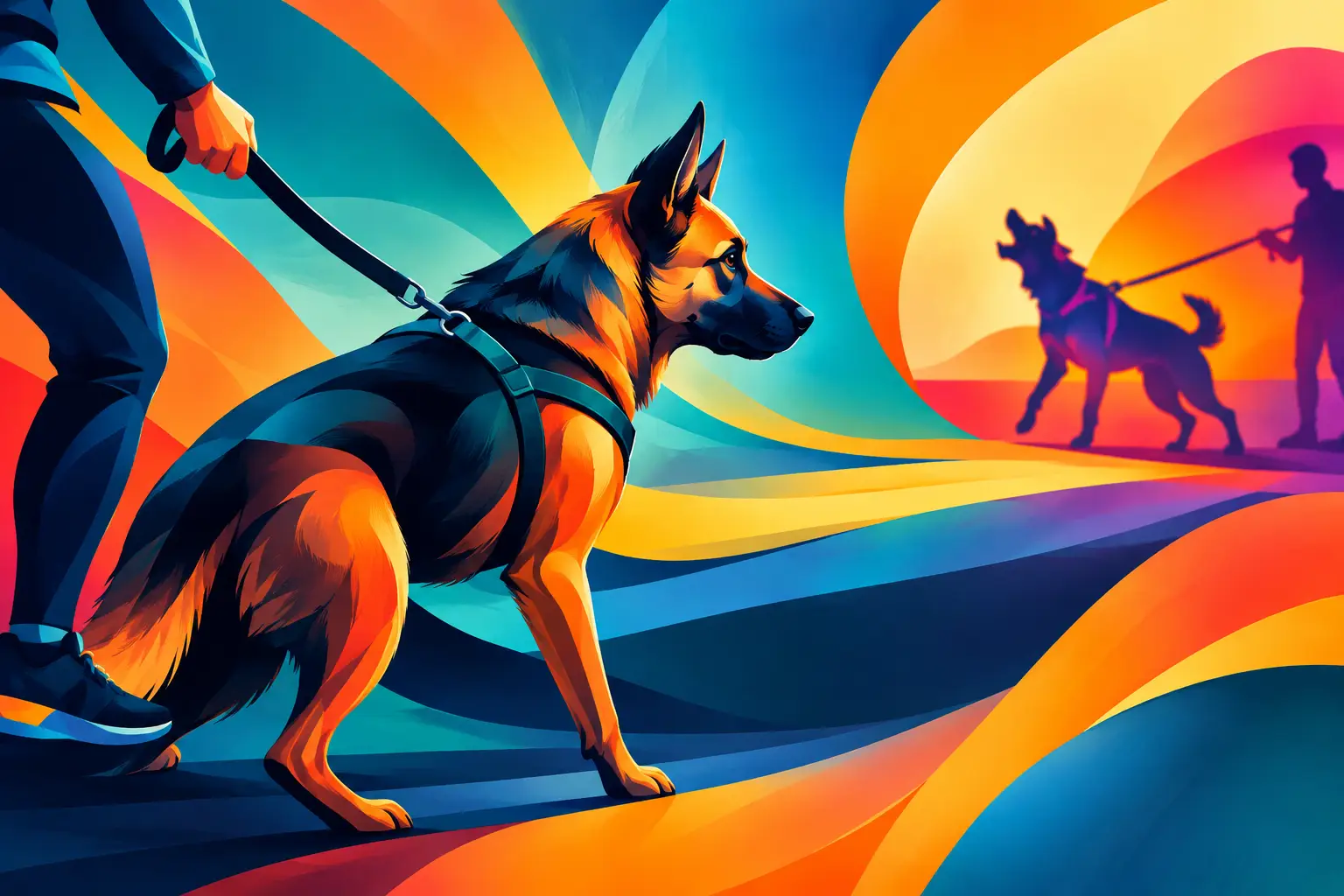
A walk can become stressful very quickly when your dog spots another dog across the road, tightens the lead, barks or lunges, and you are left trying to regain control. Dog lead reactivity training gives owners a structured way to change that pattern. The goal is not simply to get past another dog without an incident. It is to build calm handling, better obedience and a dog that can look to you for direction when the environment becomes challenging.
Lead reactivity is common in adolescent and adult dogs, including dogs that are friendly at home or enjoy playing with familiar dogs. It can be frustrating, embarrassing and, in some situations, unsafe. With the right assessment, clear training plan and daily practice, many dogs can make meaningful progress.
What lead reactivity looks like
A reactive dog has an outsized response to something in its environment. On walks, that trigger may be another dog, a person, a cyclist, a skateboard, a car or a sudden noise. The response may include hard staring, pulling, whining, barking, growling, spinning, lunging or refusing to move.
Not every bark is reactivity. Some dogs bark briefly because they are excited, while others are worried, frustrated by the lead or trying to create distance. The behaviour can look similar from the footpath, but the reason behind it affects the training plan.
It is also worth remembering that a dog may cope well in one setting and struggle in another. A quiet park at 8 am is very different from a narrow suburban footpath when two dogs approach head-on. Distance, space, the other dog’s behaviour, your dog’s energy level and previous experiences all matter.
Why dogs react on lead
Dogs do not usually become reactive because they are being deliberately difficult. Many are uncomfortable with close encounters and feel unable to move away while attached to a lead. Others become frustrated because they want to greet, chase or investigate but cannot reach the trigger. A history of frightening encounters, insufficient early social experience, over-arousal and inconsistent handling can all contribute.
Owners often make the problem worse without meaning to. When a dog pulls towards another dog, then eventually gets to say hello, pulling has been rewarded. When a dog barks and lunges, then the other dog moves away, the dog may learn that the display works. Repeating these experiences can make the response faster and stronger.
This is why waiting for a dog to “grow out of it” is rarely effective. The more frequently the behaviour is rehearsed, the more established it becomes. Early action is usually easier, but older dogs can still learn new responses with consistent training.
Dog lead reactivity training starts with management
Before asking your dog to cope near distractions, make walks more manageable. Management is not avoiding training. It is the practical step that prevents repeated outbursts while your dog learns a better skill.
Choose quieter walking times and routes where you have room to cross the road, turn into a side street or step onto a nature strip. Avoid narrow paths and busy dog areas while you are rebuilding control. If you see a trigger ahead, create distance early rather than waiting until your dog is already staring and tightening the lead.
Your equipment should allow secure, comfortable handling. A properly fitted collar or harness and a standard lead give you more control than a long lead in a crowded area. Check fittings regularly, particularly with growing dogs or dogs that have changed weight. For strong or difficult dogs, professional advice on safe handling is sensible.
Management also means being realistic about your dog’s threshold. If your dog can notice another dog from 20 metres away and still respond to you, that is a workable training distance. If they are already barking at 20 metres, move further away. Progress comes from practising where your dog can think, not repeatedly placing them in situations they cannot manage.
Build obedience before the busy walk
Reliable responses are easier to teach in a calm setting first. At home, in the backyard or in a quiet park, practise the skills you will need on the street: walking beside you on a loose lead, turning with you, sitting calmly, coming when called and giving attention when you say their name.
Keep sessions short and purposeful. Ask for a simple response, reward the correct choice with praise, food or access to something your dog enjoys, then release them. This teaches your dog that listening to you is worthwhile and understandable.
A useful exercise is a calm change of direction. Walk forward, say your dog’s name, turn smoothly and reward them for moving with you. Practise both ways, without yanking the lead or repeating cues. When this is familiar in low-distraction environments, it gives you an effective option when you need to move away from an approaching dog.
The aim is not to keep your dog in a perfect heel for every minute of every walk. Dogs need time to sniff and explore. The aim is to have a dependable position and response available when you need it.
Teach a different response to triggers
Once your dog has basic lead control, begin controlled exposure at a distance. This should be gradual. Let your dog notice the trigger, then encourage them to turn their attention back to you before their arousal rises. Reward calm choices such as looking at you, walking on, responding to a cue or remaining loose on the lead.
Timing matters. If you wait until your dog is barking and lunging, they are less able to process your instruction. Watch for early signs: their body becomes still, their mouth closes, they lean forward, their ears fix on the other dog or the lead begins to tighten. This is your opportunity to increase distance, ask for a familiar behaviour and reward cooperation.
Do not force greetings as a test of progress. Many dogs do not need to meet every dog they see, and a polite pass-by is often a better outcome. Even social dogs can become overwhelmed by constant close encounters. Calmly walking past at an appropriate distance is a valuable life skill.
As your dog improves, reduce distance slowly and only when they are consistently successful. Some dogs will progress quickly; others need more time. One difficult encounter does not erase training, but it may mean you need to make the next few walks easier.
Your handling makes a difference
Dogs notice tension through the lead and through your body language. If you brace, hold your breath and stare at every approaching dog, your dog may recognise that something is about to happen. Calm, clear handling helps give them useful information instead.
Keep the lead short enough for safety without holding it tight all the time. Move with purpose, speak once and follow through. If you need to turn away, turn early and walk on rather than standing still while your dog becomes more worked up.
Consistency between household members matters too. If one person allows pulling and greetings while another expects a loose lead and calm pass-bys, the dog receives mixed messages. Agree on the cues you will use, the standard you expect and how you will respond when a trigger appears.
When professional support is the right next step
Some lead-reactive behaviour is more than an inconvenient barking habit. If your dog has attempted to bite, redirected onto the lead or handler, cannot recover after seeing a trigger, reacts to multiple things, or makes daily walks feel unsafe, seek professional help early.
A qualified trainer can assess what is driving the behaviour, observe your timing and lead handling, and create a plan suited to your dog. Private support can be particularly helpful where triggers occur close to home, while structured reactive-dog lead training can help owners practise skills around carefully managed distractions.
Command Dog Training School has worked with Melbourne dogs and their owners since 1989, helping more than 10,000 students build practical obedience and confident everyday handling. The most useful program is one that gives you clear exercises to practise between lessons, not just advice to follow on the day.
Improvement is rarely a straight line. There will be easy walks and difficult ones, particularly during busy periods, after a poor night’s sleep or when your dog is surprised at close range. Keep the task achievable, protect your dog’s progress and practise the same calm responses often. Each successful pass-by is a small but genuine step towards walks you can both enjoy.

