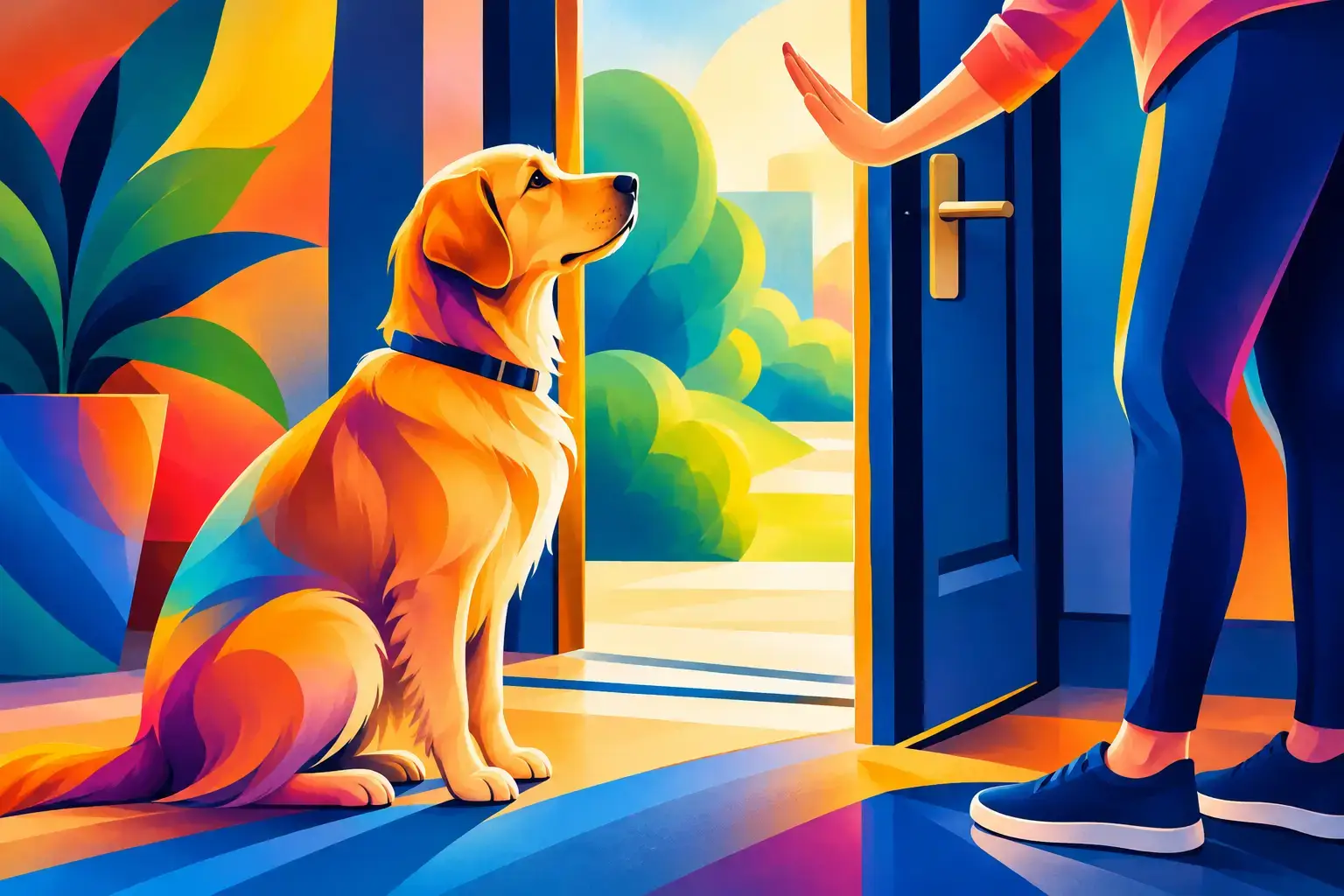
A front door can turn a settled dog into a whirlwind in seconds. The doorbell rings, a visitor arrives, or the lead comes out for a walk, and suddenly there is jumping, barking, rushing and a dog trying to squeeze through the gap first. Learning how to train door manners gives your dog a clear job at these exciting moments and makes daily life safer for everyone.
Good door manners are not about making a dog stay perfectly still for long periods. They are about teaching a reliable routine: your dog waits away from the doorway, remains under control while the door opens, and only moves through when invited. This applies to the front door, back gate, car door and even the kennel gate.
Why door manners matter
A dog that rushes a doorway can knock over children, visitors or older family members. They can slip out onto a road, dash towards another dog on the footpath or greet a guest in a way that feels frightening rather than friendly. Even a sociable dog can cause trouble when excitement takes over.
For puppies, this is one of the most useful household lessons to establish early. For adolescent or adult dogs, it may take more repetition because rushing the door has often become a well-practised habit. Either way, improvement comes from consistent handling, not from waiting until a visitor is already standing at the door.
Set up the right training environment
Start at a quiet time, when there is no delivery driver, visitor or urgent need to leave the house. Have your dog on lead if there is any chance they could bolt through the door. Keep training sessions brief, calm and frequent – several successful two-minute practices are more productive than one long session when your dog is losing focus.
Choose a waiting place a few steps back from the door. It might be a mat, bed or a clear spot on the floor. A mat can be particularly helpful for dogs that jump on guests because it gives them a visible place to return to. The location matters less than using the same place each time.
Before adding the door, make sure your dog understands simple lead guidance and a stationary position such as sit or stand. Some dogs find a sit comfortable; others, particularly older dogs or large breeds, may do better standing quietly. The goal is composure, not a particular pose.
How to train door manners step by step
Begin with the door closed. Lead your dog to their waiting place and ask them to stay there. Pause for a second or two, then calmly acknowledge the correct choice with praise and a small food reward if you use one in training. Release your dog with a consistent word, such as “okay”, so they learn that moving forward happens only after permission.
Once this is easy, repeat the exercise while you touch the door handle. If your dog gets up or surges forward, calmly guide them back to the waiting place and try again. Do not argue, repeat commands rapidly or turn it into a dramatic event. Your dog needs to learn that getting up makes the door remain closed, while waiting makes the routine continue.
Next, open the door a few centimetres. Close it again before your dog moves. Gradually build the challenge: open the door wider, pause for longer, step partly outside, then return. If your dog remains settled, release them when you are ready. If they rush, simply reset and make the next repetition easier.
This process teaches an important lesson: an open door is not an invitation to charge through it. Your release word is the invitation.
Practise both directions
Many owners teach their dog to wait before going outside but forget the return trip. Practise calm entries as well. When you come home from a walk, ask your dog to wait while you open the door, then invite them in without pulling, barging or racing ahead.
The same applies at the back gate. A dog that charges into the yard may be less of a public safety risk than one that rushes the front door, but the habit is the same. Consistent rules at every threshold help your dog understand what is expected.
Add the lead and walking routine
For many dogs, the sound of the lead is as exciting as the doorbell. Rather than clipping on the lead and immediately heading out, make it part of the lesson. Put the lead on, walk to the door, ask for the waiting position, then open the door only when your dog is settled.
If your dog pulls hard as soon as you step outside, do not expect doorway training alone to solve the whole problem. Door manners and lead training work together. A calm exit gives you a better start, but your dog also needs consistent instruction about walking beside you rather than dragging towards every scent, person or dog.
Teaching calm greetings for visitors
Visitors are a much bigger challenge because they bring noise, movement and excitement. Start by practising with a family member or friend who understands the plan. Ask your dog to go to their waiting place before the person knocks or rings the bell. Keep your dog on lead at first so you can prevent rehearsal of jumping or barging.
Open the door only as far as your dog can cope. If they remain calm, the visitor can enter without making a fuss. If your dog jumps, barks excessively or pulls towards the person, the visitor should pause or step back while you guide your dog to their place again. The greeting resumes when your dog is under control.
This can feel slow at first, but it is much clearer than allowing your dog to leap on every guest and then trying to correct the behaviour after the fact. Ask visitors not to reward jumping with attention. A dog that is greeted only when all four paws are on the floor quickly learns which behaviour works.
For highly excitable dogs, it may be more realistic to have them settle behind a baby gate, in another room or on a lead while visitors enter. There is no prize for making the exercise harder than your dog can manage. Build success first, then gradually reduce the level of help.
Common mistakes that slow progress
The most common mistake is inconsistency. If your dog must wait most of the time but is allowed to rush out when you are late for work, they will keep testing the rule. Decide on the routine your household can follow every day.
Another mistake is asking for too much too soon. A puppy may manage a closed door but not cope with a neighbour walking past, a tradie at the gate and children arriving home from school. Increase distractions one at a time. Training should stretch your dog’s ability without repeatedly pushing them into failure.
Avoid using the door only when you need to leave. Practise opening and closing it at random times, then release your dog back into the house. This prevents your dog from treating every training repetition as a signal that an exciting walk is about to begin.
Finally, make sure every family member uses the same release word and follows the same standard. Mixed messages are especially confusing for puppies, but adult dogs also benefit from predictable handling.
When extra help is worthwhile
Door rushing can be more than a manners issue when a dog reacts aggressively to visitors, guards the entry, panics when left behind a barrier or has escaped before. In these cases, management comes first: use leads, secure gates and physical separation to prevent an incident while you work on the behaviour.
A structured training program can help owners practise timing, lead handling and controlled distractions safely. Command Dog Training School has worked with Melbourne dogs and their owners since 1989, from puppies learning household routines to adult dogs needing more individual behaviour support.
A calm doorway is built through small, repeatable choices. Practise when nothing urgent is happening, reward the waiting you want to see, and give your dog a clear invitation to move. Before long, opening the door can become an ordinary part of the day rather than the moment everything falls apart.